

Before writing a definitive answer, I thought I would get an assessment from the one person who knows me better than any other of the eight billion human beings on this planet.
Mrs B and I have been together for some 54 years. I asked her what legacy she thought I would leave behind after I’m gone. “For a start, you’re a dypso,” she retorted. Harsh, but probably true. “You’re also a very kind person.” That, I believe, is a compliment. “You can get very grumpy.” I’ll allow that one on the grounds of old age.

In reality, I really don’t care. I’ll be dead. Gone. Extinct. Stiff, like Monty Python’s parrot. A legacy is really like a funeral. It has little to do with the deceased, but everything to do with who is left – close family and friends in particular. I suppose they would care about what kind of legacy I’d leave behind.
I’ve spent most of my life making music of some sort, so I would like to think that has benefitted artistes with whom I have worked over the years, as well as people who have listened to my playing and recordings. I was on the radio for nearly a quarter of a century, and I do know I have made a positive impact on many listeners, because so many took the trouble to tell me so.
But here’s the rub. Most of these lovely people will be dead within the next two decades, and with them, whatever my legacy was will also terminate. Eventually, no-one will remember or care about me, and who I used to be! I’m not a Beethoven, Shakespeare, Einstein, Bannister or Brunel, so really, I am nothing.
So, a kind-hearted grumpy old dypso is fine by me.
My Legacy

My first legacy is my kids. Hopefully, my daughters will live on when I’m gone and carry on memories about me. Yet, this is a kind of ‘built-in’ legacy that people see in their children.
Another side of my legacy is my work as a professional writer and journalist.
I would even close up on specific areas of my activity.
First, it is my Alaskan research and projects through the years. This journey started in 2011 with my first trip there and continues throughout my life. As the project creator and an executive producer, I shot a documentary there that year with a fantastic crew that I signed in. The documentary was dedicated to contemporary Alaska and its Russian heritage.
Then, in 2014, I published a book about my Alaska experience, actually a travelogue. I called it ‘Letters from the Land’s End: A Journey to Russian America.’ That was another milestone on my way, inspired by Alaska and its people.
In 2016, I won a Fulbright grant in the ‘Creative Writing/Journalism’ category with my project ‘Russian America’s Seventeen Moments.’ In this case, I’d say: Amat Victoria Curam. I invested lots of my creativity and time to succeed in winning the grant among strong competition and, later, to implement the project on Alaskan soil. Unlike my first ten-day visit to the 49th state, this time, I spent more than three months implementing my project as a Visiting Scholar at the Anchorage Museum under Dr. Aron Crowell, the head of the Arctic Research Center there, guidance as my mentor.
This was the most unusual time of my life. I stayed at my host family, Jim Lanier and Anna Bondarenko’s house at Chugiak. I first met them back in 2011 and I have the warmest memories of them and my time there in 2017.
I was entirely on my own, making my project’s road map and meeting seventeen people – as Alaska’s seventeen moments – to interview them across the state. I have visited places I have been to before, like the island of Kodiak, and have met old friends from 2011, like Robert ‘Gus’ Gustafson. I have been seeing new faces and new places, too many to mention here, but all of them are imprinted on my project.
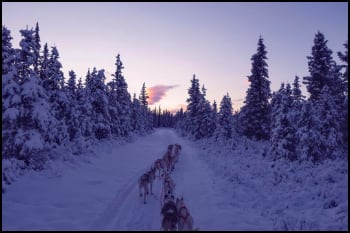
Thanks to Jim, I’ve had—and enjoyed—a unique experience helping him with dogs as he is one of Alaska’s most famous mushers. We travelled across South Central Alaska, riding dogs in the taiga at night and during the day, using a snowmachine and sled. Deep in the forest on a December night, with no city lights, I saw the Pleiades shining right above me, up in the sky. What a magic, Jack London-style feeling!
Thanks to Juneau’s Alan Engstrom, I’ve seen the beauty of Southeast Alaska with its mighty ocean and beautiful mountains, covered with deep-green spruces.
Thanks to the project, I’ve met amazing people and visited terrific places there to keep my memories about them through the years.
Through my project, I’ve tried to bring my impressions and emotions about Alaska, its beautiful locations, and its people to a broader audience.
Later, in Russia, I delivered numerous speeches about Alaska at venues like the Russian Geographical Society and the Russian American Historical Society. As a travel expert, I have spoken several times about Alaska on Vesti FM federal station, talking about Russian America’s Seventeen Moments and expanding it with information on Alaska’s history and its contemporary state of affairs. As a Fulbright alumnus, I was invited to speak at their Moscow office about Alaska with an Alaskan guy living in Sitka, Brendan Jones, my fellow Fulbrighter. It was fantastic to revisit Sitka with him at a Moscow pub soon after our joint session at Fulbright!
And the second part of my legacy is my RUSUK experience, both personal and professional. This project goes on every week since October 2017. I call this creative collaboration a unique one, and it truly is. Professionally, thanks to RUSUK, I have developed my English writing skills to a degree that I primarily work as an English writing author. Roger and Dean have really impressed me in many ways, from their background to their lifestyle. I keep my memories of running and biking with Roger on the hot Cyprus mornings. I remember a cool experience: tasting scotch vs bourbon with Dean. They are true personalities and fascinating people to know, and I truly admire them.
So, these are two sides of my hypothetical legacy that I have now. Maybe something else will appear as time goes by. My legacy is the journey I am experiencing every day.
What legacy would I want to leave?

What you want people to remember you for after you die is a deep topic. I’m not likely to answer deep dish pizza or dancing girls. When you kick off you want people to cry and stuff but not too much.
Before we get too far into this there are things you maybe want to know about me.
I went to this fancy all-boys school in America. In fact, one of the top five private secondary institutions in the country. I went on a full-ride with a bunch of privileged rich kids. One guy in the class ahead of me took a different Rolls to class each day of the week. Whatever.
My best mate Tom Casey and I had a friend named Timmy Lupton. Yeah, those Luptons; Tom’s dad was General Manager at Chattanooga Glass. You may know them better as the Cocoa Cola Bottling Company. Timmy lived across the street from Tom and came over one day and discovered Tom’s bedroom was only one room. Timmy was honestly surprised to learn that not all bedrooms have a dressing room; or any extra rooms for that matter.

Years later I owned a small business in Fairfax County, Virginia. This was the second richest county in America and we went from one McMansion to another all day. Huge homes filled with unhappy people. Half the houses were half empty, not one stick of furniture in the extra rooms. These people were house poor.
I reject money as a measure of success. Many people measure success by how much money you died with. I think you may not understand what I just said: I reject money as a measure of success. Yes, I acknowledge money is a measure of success for many. I admit the guy with the fastest car will get more dates.
I simply don’t have the ink space to explain this in detail but I reject the idea that there is a direct relationship between happiness and money. Unless that relationship is on a negative graph. I have been around more money than most our readers can even think about so I am comfortable in my stance. Yes, I admit that there is a relationship between money and happiness in that if you have no money at all you will not be happy. You will have no food and no home. In return, I will argue that the relationship between money and happiness isn’t simply overstated, it’s a lie. The average person thinks that if he makes $150k, he will be truly happy if he can just claw $175k. Just that little extra will make him happy. Guess what? When he gets 175, one 185 becomes the new, magic number. This person will never, ever reach his goal: happiness.
As for my legacy, I would be disappointed if someone called me successful. I don’t want to be successful, I want to make the small part of the world around me better. I have four dogs, all right off the street. Three cats who had no home or hope. No human or animal has ever been turned away from my gate. I reject the standard definition of success.