

I have grown to dislike the word “immigration”. Not because of what it means, but because of what it has become.
Today, the word is often used as shorthand for a problem. Mention immigration and many people immediately think of overcrowding, pressure on services, crime, cultural change, or economic competition. It has acquired a negative connotation that would have seemed strange only a few decades ago. Increasingly, it is used to inspire fear, resentment and division. At times, the language surrounding the issue carries uncomfortable echoes of Europe in the late 1930s, when people were encouraged to blame entire groups for society’s problems.
Politicians of all parties have discovered that immigration is an issue capable of stirring strong emotions. Too often, those emotions are fear and resentment rather than understanding and gratitude.
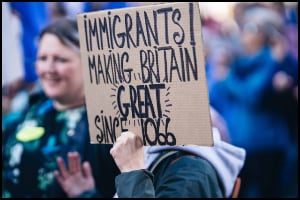
The irony is that without immigration, I would not be here. My parents were immigrants. My father served in the Polish Army during the Second World War. My parents arrived in Britain in 1945 with little more than £5 to their name and not a single word of English between them. They left behind uncertainty and hardship in the hope of building a better future.
Had they stayed in Poland, my life would have looked very different. I would have grown up under Communist rule until the end of the 1980s, queuing for basic necessities, living with restrictions on personal freedom, and knowing that ambition and talent often counted for less than political circumstance. Even if I had qualified as an architect, my rewards would have been little different from those of an unskilled labourer.
Instead, I grew up in Britain. I experienced freedom, opportunity and optimism. I witnessed the excitement of the 1960s, the cultural revolution of Carnaby Street, the music of The Beatles, the joys and frustrations of supporting Arsenal, and a widespread belief that tomorrow would be better than today.
Britain itself is a product of immigration. Hundreds of languages are spoken across the country. Countless cultures from every continent have found a home here. People practise a vast range of faiths — and crucially, are free to do so. This extraordinary mixture of backgrounds, traditions and experiences is increasingly portrayed by some as a weakness.
I would argue that it is exactly the opposite. Diversity has enriched Britain in almost every conceivable way. It has fuelled innovation, creativity, entrepreneurship and scientific progress. It has strengthened our healthcare system, our universities, our businesses and our arts.
My brother-in-law, who reached the highest levels of his profession as an anaesthetist, often remarked that some of the finest doctors and nurses he worked alongside came from the Philippines. Across the country, immigrants have taken on jobs that many British people were unwilling to do, and they have done them with dedication, professionalism and skill.
Yet more and more people are being encouraged to see this diversity as something threatening. I see it differently. The Britain I know and love was built not despite its diversity, but because of it. People from different countries, cultures and backgrounds have helped make this nation prosperous, creative and outward-looking. They have contributed to our economy, our communities and our national character.
What worries me is the growing tendency to divide ourselves into categories: natives and newcomers, us and them, tribes and factions.
Surely there is a better way. We should not be defined by where our grandparents were born, what language our parents first spoke, or which faith we follow. We should celebrate the things that unite us rather than obsess over the things that separate us.
In the end, perhaps the answer is quite simple. We should stop worrying so much about labels and start celebrating what really matters: being British.
Immigration

Based on the ‘Out-of-Africa’ concept, which has every scientific proof, from paleoethology to archeology to genetics, we’re all immigrants, more or less. Even those who stayed in Africa have changed their habitats a few times; I mean, we’ve all been moving as mankind throughout our history.
They say America is the land of immigrants, but let’s look at what happened to Britain for the last several thousand years, back to the times when Dogger Land, now submerged in the North Sea, was still above the surface. The British Isles have experienced numerous waves of migrations, from Celts (and some people before them, like Picts, I suppose) to Anglo-Saxons to French, and now, to plenty of people from Asia, Africa, and the Caribbean.
The modern territory of Russia is another crossroad of civilisations since time immemorial.

I think the real issue is not race or nationality, but the cultural aspects. When refugees from Syria or Algeria try to establish their own isolated communities within European countries, I think it is a real threat to European civilisation as we know it.
Angela Merkel has officially admitted that letting a million Syrian refugees into Germany was a regrettable mistake and the multiculturalism didn’t work. These millions of people in Germany have never become Germans.
I agree with her 100% as I see some things like that happening in Russia when numerous Asian communities are changing the landscape. The state must get them integrated into the existing civilisation framework or the framework itself would change.
And this would be another Russia, another Britain, and even another United States of America. History shows are plenty of cases of this kind when nations were losing their identity and vanishing.
Do we really want it?
Immigration

Help me out here – can you think of a single issue that’s getting more attention in almost every country around the world right now than immigration? The three RUSUK writers represent countries that span three continents and immigration is a major issue in all three. I’m thinking Trump may come in a close second but that’s more clownish TV show than substantive issue.
North America may be something of an outlier here, humans are not native and so every last one of us is an immigrant but that’s probably another topic. When we say immigrant, what we really mean is anybody that came the day after my folks arrived. In my country, Scottish Highlanders received a cold welcome from us British and ended up moving all the way out to the mountains. They became immigrants for the colonials and the natives, and were unwanted by both.
In the early 1900’s, the Italians came in large numbers. Newspapers with help wanted ads from the period offer pay based on ethnic background. The Italians came in at the very bottom. As an aside, the ad I have held in my hand was from New York State and it had five categories of pay. Negros were paid better.
This is a repeating pattern throughout American history. Every last group was discriminated against as soon as they arrived in large numbers. By the second generation, their grandchildren think of themselves as American and cannot speak their former mother tongue. It happens again and again… and yet, the older immigrant groups seem unable to figure out how this works.
I suppose many European countries can be excused for not understanding this. After all, a country like France is really dealing with this for the first time. OK, not counting invasions and such. You can’t blame a fellow for something he doesn’t know.
Many nations seriously NEED immigration, like now and in real numbers. We are living longer and require more advanced medical support later in life. I know you already know all this; younger workers pay taxes and support the government. Many countries have a population/age chart that looks like an inverted pyramid. These countries are in real trouble. Will China remain a world power? Not without immigration; which they don’t want.
When Putin went to war with Ukraine, what national asset did he take? Minerals from the Donbas? Nope. The folks at The Hague would like to have a little chat about 20,000 children. The most valuable thing Ukraine had was children; little white children, with Slavic blood. As they say, hindsight is 20/20 but allowing 50,000 young adults to immigrate would have been so much easier. I’m not saying that was his main motivation, but immigration, or lack thereof, played a role in that war.