
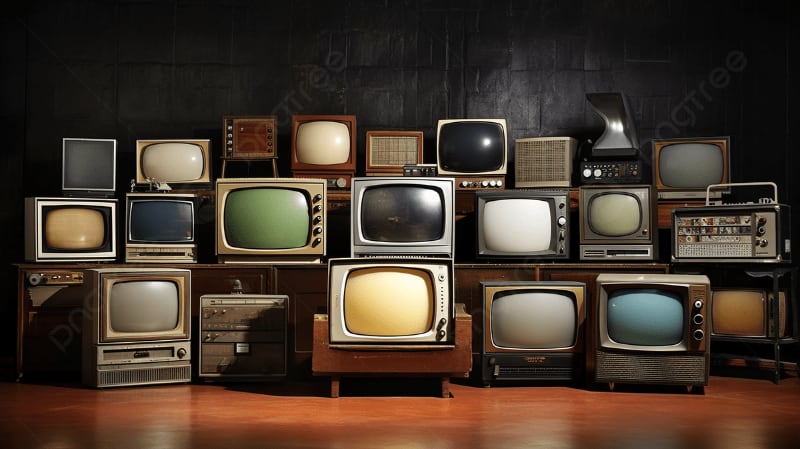
Not really. But partly, yes, it is dead.

I mean, I don’t watch Russian TV channels as they broadcast either BS or propaganda. I actually quit watching it long time ago.
On the other hand, I still use my flatscreen TV set. It is LG, by the way. However, it is not air transmission but internet streaming.
I watch online services that stream either movies, series, or sports, football being the #1 choice.
For instance, I enjoyed watching the World Cup on OKKO TV, which is a local online streaming service.
Sometimes, I watch foreign series. However, it may be tricky as under the current Russian law, any mentioning of gay issues is prohibited now. On the outcome, you watch a series and at some moment may simply lose the point of the plot because they simply cut out the scenes that may have any relation to gays. So, it may affect the plot!
It sounds stupid and horrifying, but this is the weird reality Russia now lives in.
I can only hope that when the Great Leader will somehow leave us, there would be a fast comeback in every sphere of live – back to normality.
Is my T.V. set dead?

I have always remembered that wonderful day back in late 1960, when walking home from my mate’s house. My neighbour passed me in the street, and said those immortal words: “The television aerial is going up on your chimney!”
Wow, my parents had finally achieved it. They had bought (or probably rented) our first T.V. set. There were only two channels available, BBC and ITV. We lived close to an RAF station, where Canberra bombers would often pass overhead regularly, totally destroying the television reception! But from then onwards, right up to today, there has always been a television set in my house, often two, and sometimes three.
Today it’s two; we have a fairly large screen in the living room, and Mrs. B has a smaller set in her bedroom, largely because she sadly has to spend more time in there than either of us would relish. Together, we watch T.V. series that take our combined fancy, always the BBC news in the evening, and I watch sport sometimes when a visit to the football pub up the road is ruled out because of my excessive wine consumption. I know that’s hard to believe.
We are both computer literate, and both have iPads and iPhones, but we simply wouldn’t dream of watching television programmes on a tiny screen. Why on earth would we?
There is something rather comforting about sitting back in a chair, looking at a proper-sized screen, and actually watching something rather than peering at it through a letterbox-sized rectangle held six inches from your face.
Our television sets are most certainly alive and kicking, and are receiving plenty of “on” time; I do not foresee any occasion in the future when that will not be the case.
So, while the television may apparently be dying, mine has clearly missed the memo.
Is my T.V. set dead?

In the US, traditional broadcast television is in decline. Cable, thankfully, is also losing customers in what seems to be an irreversible trend. I say thankfully because several cable companies, most notably Comcast, rank consistently as the most hated corporations in America.
In the US, a cable company will purchase a license from a local government to run lines and install infrastructure. They pay for exclusive rights to an area. The practical upshot was that during the eighties and nineties, these companies became predators. They would use their exclusive monopolies to force people into buying “packages” of channels they didn’t want. When pulled into court they would claim cable companies were not monopolies at all and there were several major companies competing in the space. However, for any one home, there was only one choice.
Obviously, when streaming came along, most people, including me, were more than happy to “cut the cord”. This put more pressure on traditional broadcast media. The irony here is that the cable companies themselves acted against their own interest and created an environment where many Americans were happy to search for alternatives.
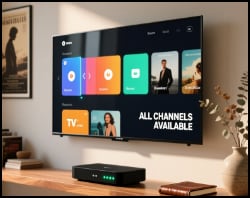
Technology only compounded the problems for traditional TV. Cable TV needed a set-top-box with a hard wire. You were physically tied to the main TV set. Wi-Fi made it possible to break out of the living room and take the TV with you. At the same time, YouTube and Netflix both started streaming video on demand. The damn broke.
Today I have a TV in the living room but it is almost never, ever used. When we have guests, I may use it as a music player, streaming from my laptop. It is on in that role maybe four or five times a year. I think the only exception to that is if one of our guests happens to be a child. We can stream cartoons or children’s programming from several different countries.
The average American spends a little over seven hours a day in front of a screen and almost all that is online. While I may celebrate the fall of cable, I regret the loss of broadcast TV. Full disclosure: I worked in broadcasting for 18 years. I think having a serious, major news broadcast every night is important. Independent news is critical to a healthy society and without it we end up exactly where most Western nations are today. All these little silos where only half the story gets told under a layer of so-called commentary. But that’s another blog.
The TV set is dead in my house. If something happens to this one, I doubt I would pay to replace it.