
Germs Rock!

When we think about finding life on some far-away rock, we normally think Little Green Men. Maybe they look like a skinny version of us, except with big bug eyes and grey skin. And they are smart, and they have cool flying saucers. What’s up with the anal probes?
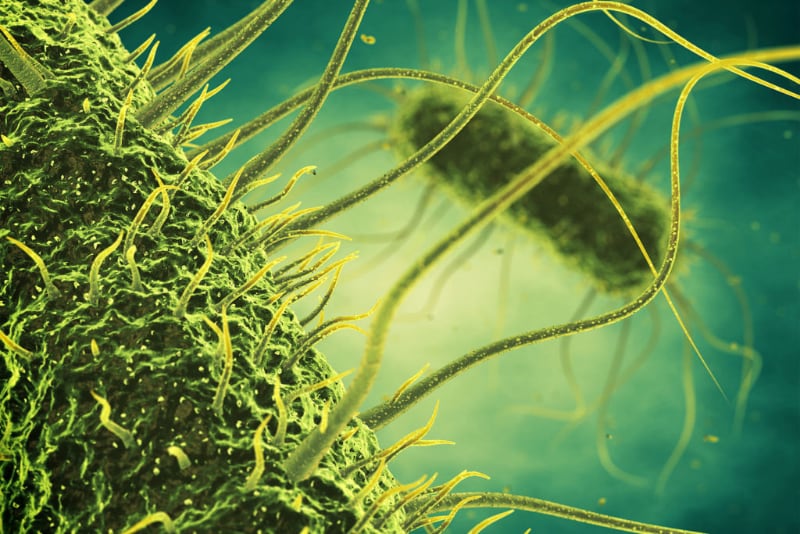
But that’s not what we are likely to find first. About once a month another team of scientists make another discovery here in the Solar System that could be a sign of life. For example, Methane in the Martian atmosphere. So, there’s yet another scramble that involves some rando volcano and some rocks with pixie dust. After several of these non-biological explanations, it looks far easier to just say the most likely explanation is single-celled life.
Carl Sagan said “Extraordinary claims require extraordinary evidence” and I’m all good with that, but lookie here, that non-biological explanation scaffolding is starting to look pretty rickety. Just more and more, and after a while it would be so much simpler to just say it LOOKS like life is the most likely explanation.
So, the question is what would happen if scientists just said it: “We think we have discovered life.” Obviously, that would be the only thing on the news for weeks. Breathless coverage of every random rock. But I think it would calm down after a while and daily life would return to normal.
It would be much the same if we discovered intelligent life. Just to a higher extreme; then, just like with the single-cell critters, it would calm down and we would get back to normal. Unless they decided to send us a message. All bets would be off for the rest of the year… but once the enormity wears off, it really doesn’t change anything down here.
In either case I think the budgets for space and science would go up in every country across the planet. That would be a good thing. Lots of basic research into all kinds of medical and life sciences and the budgets for space exploration would go through the roof. Young people would get STEM Degrees of all kinds. Every time some rocket company develops a new engine, it would be the lead story on the news. The benefits would be positive for all mankind, everywhere. In my simple mind, this would be the real benefit of finding bacteria in the atmosphere of Venus.
It wouldn’t take long for some smart guy to figure out that everywhere life can exist, it does. Here on Earth, we call them extremophiles and they live in places we can’t. I see no reason to think Earth is special in that regard. I bet there is life on five or six bodies here in the Solar System and they will be future Collage Recruitment Ambassadors. Germs Rock!
Will life out there affect us here?
Absolutely not. Ever.

Even though I’m no astro-biological genius, there simply must be life, particularly simple single-cell life of some sort, somewhere out there in our Universe. Trillions of galaxies, each containing trillions of stars, most with planets nearby, the odds are stacked in favour of life being present. Not just now, but anytime in the past 13 billion years, and don’t forget that the Universe is ever-expanding and life has more billions of years to still evolve in the future.

Now, whether these life forms ever advance into civilisations is a moot point. Remember, for billions of years, our own little planet Earth, revolving around an insignificant star in an equally inconsequential galaxy, was home to single-celled creatures, who floated through our oceans in solitary bliss. Modern intelligent life is a very recent phenomenon. It so very nearly didn’t happen, and statistically, it was a one-in-a-million chance that it did.
Will discovering that kind of unassuming cellular or bacterial existence, either in our own solar system, or beyond, have any impact on us eight billion or so souls on this planet? Of course not; “Hey guys, we’ve found some bacteria on Pluto!” Who would give a damn, apart from a few astronomical nerds like us three RUSUK bloggers.
OK, so let’s assume, against all the odds, that life does progress into something intelligent and civilised, somewhere. A bit like us, or even more advanced. It could have happened anytime in the past, thus we’d never have known about it. Just suppose intelligent life is around right now. Because of the sheer size of our Universe, we will still never know about them, and they will never know that we exist.
And, of course, it won’t be long before us humans completely destroy our home planet, we’re well on the way, though we will probably blow each other up beforehand. It appears that’s what civilisations do. Astronomically, we on Earth will be long gone very soon, so the question will have no relevance. In the greater scheme of things, a bit like us humans.
Will life out there affect us here?

Part 1: Give me a single reason why alien life will not affect the Earthlings and the whole life on our beloved and beautiful planet.
I don’t see any.
This will be the biggest news, as it has been predicted and described in numerous sci-fi novels, philosophical books, and, I suspect, top-secret governmental papers.
Meeting another civilization would be a fundamental change in mankind’s history. Some fear they can invade and enslave us or intoxicate us. However, they can also be partners or even wise tutors. Nobody knows.
Another question is, who exactly can we meet? What form are the spacers? They can be Martian bacteria, as I expect in the next ten years. Even in this case, discovering alien life would be the most significant mental revolution. Even those tiny creatures can affect us in a way. At least, in our minds: Hey, we are not alone! If there is life on Mars, on our neighbouring planet, it must be present elsewhere in the Universe.
I could go on about this issue, as I believe in the existence of ET life forms. I consider them not super widespread, but they are still not too rare in our Universe.
But I would like to bring our attention to the fact that an alien spaceship has already visited us.
Part 2: Oumuamua
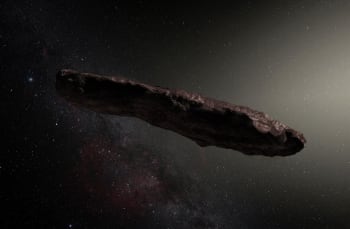
It was the name given to the first known interstellar object to pass through our solar system. It was discovered in October 2017 by astronomers at the Haleakalā Observatory in Hawaii; its name comes from the local language word meaning “scout” or “messenger.”
This space stranger was extremely elongated in shape, like a cigar, probably up to 400 meters long. It travelled at high speed, indicating it was a visitor from another system, not part of the Solar system. It didn’t have a visible cloud of gas and dust like typical comets or asteroids.
Could Oumuamua be an artificial object? Possibly. Its trajectory resembled a spaceship route, navigating through our Solar system to reach even farther worlds. Astronomers couldn’t assess its nature and origins because of its extremely high speed. One fact is true: it was the first proven interstellar object. Another fact is true: it was not proved to be an artificial object.
That’s a revolution in astronomy. Is it in the history of humanity?